
Irving Resident Lookup Record Paths
Irving has no official all-resident directory. A sound resident lookup instead starts with the record relationship that fits the question. The Dallas Central Appraisal District search identifies the owner or business name attached to a property record. The Dallas County deed index supplies recorded-party and instrument history. Court, vital, and archive sources each answer narrower questions. An owner of record is not automatically an occupant, and an old directory entry is not proof of a current address.
| Record layer | What it can confirm | Custodian | Access route |
|---|---|---|---|
| Appraisal roll | Property address, owner or business name, value, and type | DCAD | Online address, owner, account, business, or map search |
| Recorded instrument | Grantor, grantee, document type, and recording trail | Dallas County Clerk | Online index, counter, mail request, or eligible e-certification |
| County or municipal case | A case-index match in a particular court and date range | Dallas County courts or Irving Municipal Court | Portal, clerk contact, records request, or counter |
| Vital record | A qualifying life-event record or verification | Dallas County Clerk or Texas DSHS | Office, mail, phone, forms, or eligible online order |
| Historic directory or archive | A dated connection to an address, school, family, or institution | Irving Archives or libraries | Collection guide, digitized volume, library, or reference request |
Choose the first route from the information already known. An Irving address points to DCAD and the deed index. A known court and date point to the right court portal. An older family question may be better served by an archival directory, obituary, or newspaper index than a current system.
Court Names in Irving Resident Lookup
The Dallas County Courts Portal is one name-search surface, not a countywide identity file. Its Smart Search calls for a last name and first name, offers an optional middle name and name type, and provides court-location and advanced-search controls. Use a cause or case number when one is known. District Clerk, County Clerk, justice-of-the-peace, probate, and municipal routes are not interchangeable. A miss in one court only describes that search scope.
| Search field | Last and first name are marked required in the county guide; middle name is optional. |
|---|---|
| Search mode | Party name or cause/case number, with a Search Cases option. |
| Location control | Court Location defaults to All Locations and can be narrowed when the court is known. |
| Result note | Keep the cause number, court, case type, filing date, party role, and docket events with the retrieval date. |
For Class C traffic or city-ordinance matters, use the separate Irving Municipal Court route. It provides case search, docket viewing, and court-record requests. County cases and municipal cases should be labeled by their own court, not combined into a single claim about a person.
Open the Irving Municipal Court record route before relying on a case lead.
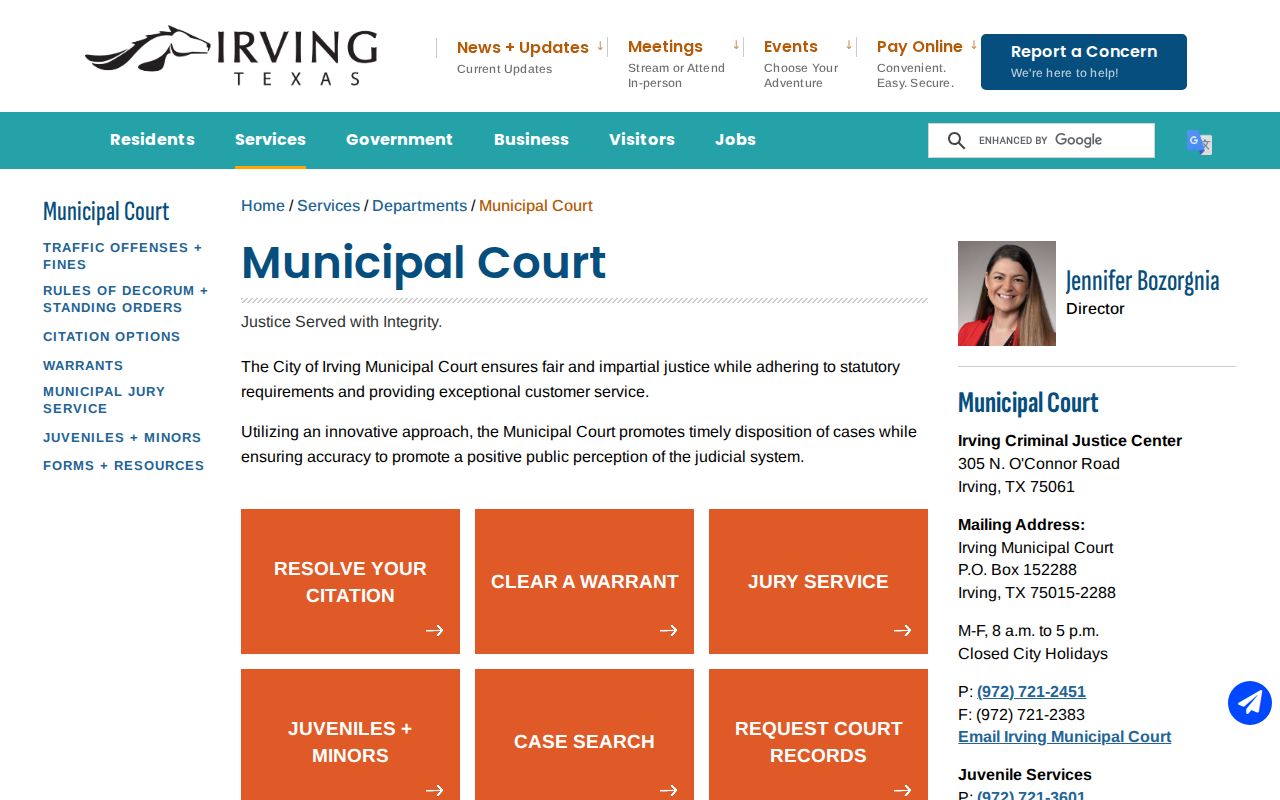
The municipal page distinguishes its own case-search, docket, and records-request paths from Dallas County court systems.
Verify an Irving Resident Match
To look up a resident without confusing two people, build a short source trail. Start with a non-sensitive fact that can be checked, such as a property address, a past directory year, or a known court. Then compare names, dates, record roles, and jurisdiction. DCAD results can show a property address, city, owner or business name, total value, and account type. The page does not establish who occupies that property. A deed index can add an instrument and legal-description trail, while a court hit only establishes a party-name match within that court.
- Check the address in DCAD and save the account or parcel identifier, the legal description, and the retrieval date.
- Search the Dallas County deed index by recorded name, subdivision, document type, or number, then compare the indexed parties with the parcel details.
- When a court connection is relevant, use the correct county or Irving court, narrow by middle name, date range, court location, or cause number, and record the party role.
- Ask the custodian for a certified copy only when a formal record is needed and the office confirms that the requester may receive it.
- Docket
- A court's dated list of case events. It records activity in a case, not a complete biography of a party.
- Index and image
- An index lists searchable fields. An image is the scanned record itself and may have different access or copy rules.
- Certified copy
- A copy issued or authenticated by the custodian for uses that require the office's certification.
Note: Keep each source relationship separate, such as owner of record, grantor, grantee, party, or historical directory entry.
Irving Resident Lookup Vital Access
Vital records can verify a specific life event, but they are not a shortcut to a current-person list. Texas makes birth records public after 75 years and death records public after 25 years. More recent records require a qualified requester, identification, documentation, and the office's current rules. The Texas DSHS applications menu provides routes for birth, death, marriage or divorce verification, adoption, correction, and related requests. An online order is nonrefundable and the research notes typical processing of 20 to 25 business days.
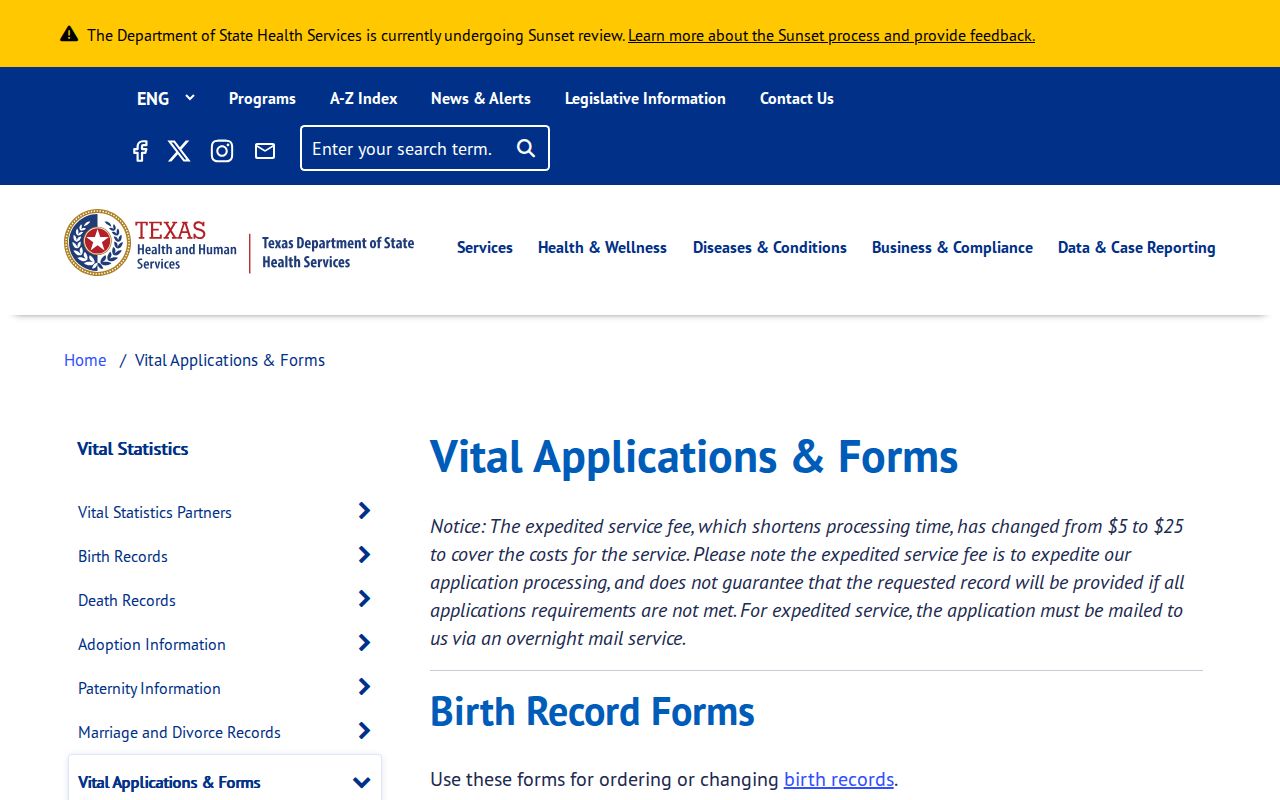
The state form menu helps separate a verification request from a certified record request before personal details are supplied.
Dallas County also has a local vital-record route. For current payment methods, office details, and copy categories, consult the Dallas County vital-record fees page before contacting the clerk. The research recorded marriage search or certified copies at $10, birth search or certified copies at $23, and a death copy at $21 for the first copy plus $4 for each additional copy. Those operating details can change, so verify them with the office.
Use the Dallas County payment and fees route to confirm the local process.
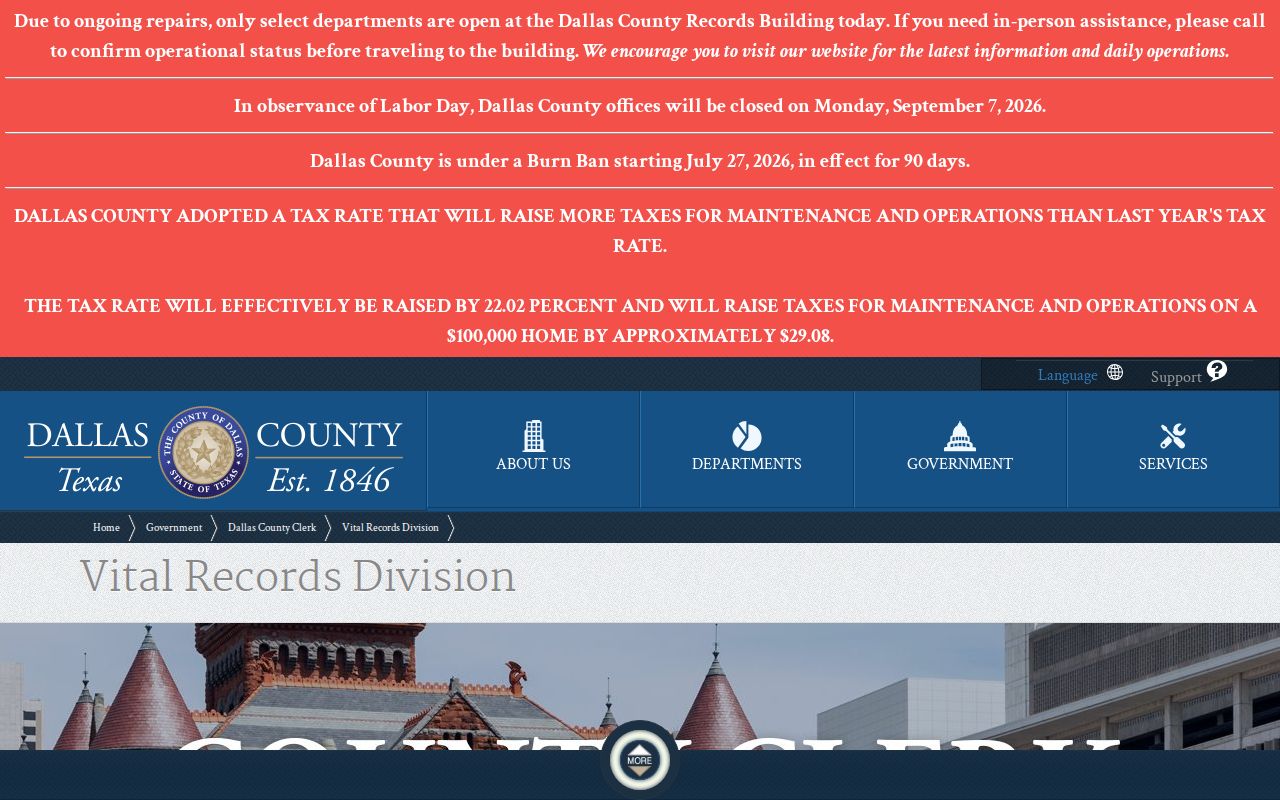
The county page is the practical check for local copy categories, payment limits, and the clerk's current office route.
Note: A vital-record verification and a certified record can have different eligibility, processing, and evidentiary roles.
Irving Resident Lookup History Checks
Older Irving research often begins outside a current portal. The Irving Archives collection guide points to families, officials, schools, churches, clubs, photographs, oral histories, obituaries, and artifacts. Dallas Public Library adds directories, telephone books, maps, newspapers, county records, and microfilm. The digitized 1937 Dallas directory on the Portal to Texas History has Irving street and name-index material, but OCR should be checked against the page image.
These are dated associations. A directory may list a household name, occupation abbreviation, spouse marker, or owner notation, and its volume key controls the meaning. When an old address needs present-day record context, the historical volumes are more fully described in the Irving city directory collections.
Irving Resident Lookup Privacy Limits
Texas law and custodian rules limit what can be copied or republished. The Texas Secretary of State describes voter-address suppression and confidentiality routes for qualifying people and protected victims. Form 21-19 is one confidentiality route, and the state also identifies related address-protection programs. The Texas Data Privacy and Security Act gives qualified consumers rights against covered private controllers, but it does not erase a public deed, court judgment, or other government record from the custodian.
Lawful use. Use Irving records for personal, lawful research. Do not use a name, address, or record detail to stalk, harass, intimidate, dox, or harm anyone.
Protected vital information, juvenile information, victim details, Social Security numbers, driver-license details, and protected residential addresses should not be compiled into a profile. Ask the custodian about a correction or confidentiality process when a record appears incomplete or protected.
Irving Resident Lookup Request Routes
A closed, blocked, or incomplete portal does not end the search. For city material, Irving asks requesters to check its Open Data Portal first and then use the City Open Records route. The Texas Public Information Act, Government Code Chapter 552, applies to existing reasonably described records held by the right governmental custodian. It does not require a city or county office to create a new report or answer a broad research question.
For a County Clerk document, the alternatives include the online index, the counter, phone contact, a mail request, and eligible e-certification. The mail form accepts a recorded name, instrument number, document type, or property address and distinguishes plain from certified copies. Libraries and archives are the fallback for historical directories, newspaper material, and finding aids that county portals do not expose. If an office is unavailable, record the official route tried and the date rather than assuming the record does not exist.
Dallas County Central Records announced a temporary service and move notice effective April 6, 2026. Some criminal, probate, civil, and other year ranges may be inaccessible or available only at specified locations during that move. Check the Central Records notice before planning a counter visit or relying on a portal's current range.
Note: A narrow request naming the custodian and existing record type is easier to route than a request for a person report.
Irving Resident Lookup Match Limits
The strongest Irving resident lookup result is a set of consistent, dated records, not a single search hit. Names repeat. Addresses change. A trust, entity, mailing address, or former owner can appear in a property result. Court data can be supplied as is and may be incomplete or restricted by case type. A current voter-status page is not an unrestricted voter file, and the Dallas County lookup returned an HTTP 403 during research, so its live fields should not be guessed.
Use the source's own label. A deed names a grantor or grantee, an appraisal search names an owner of record, a court index identifies a party, and an archive can document a historical subject. Preserve the portal name, search date, search terms, and account, instrument, or cause number. That discipline makes it possible to revisit a result without exposing unnecessary personal details.