
Irving City Directory Collections by Year
Irving city directory research begins with the surviving runs, not an assumption that every year exists. Dallas Public Library's directory list records Irving volumes for 1937, 1954-55, 1961-64, 1966, 1968-79, and 1981. The library also lists Irving telephone directories for 1954-58, 1960, 1970-88 with gaps, 1990-91, 1993-95, 1995-96, and 1998-99. Those gaps are part of the evidence. They can mark a missing volume, a changed series, or simply a year that must be checked in another repository.
| Directory collection | Documented years | Where it is held | Access route |
|---|---|---|---|
| Irving city directories | 1937; 1954-55; 1961-64; 1966; 1968-79; 1981 | Dallas Public Library Dallas History & Archives | Directory holdings, print or microfilm research |
| Irving telephone directories | 1954-58; 1960; 1970-88 with gaps; 1990-91; 1993-95; 1995-96; 1998-99 | Dallas Public Library | Telephone-book and local-history holdings |
| Digitized Dallas directory with Irving entries | 1937 | Portal to Texas History | Free page images, metadata, OCR, and indexes |
| Texas State Library Irving list | 1961; 1968; 1969; 1971-79; 1981 | Texas State Library and Archives Commission | Reference or request route |
The Texas State Library list overlaps part of the Dallas Public Library run and adds 1969. That makes it a useful gap check, not a claim that the two shelves hold identical copies. City directories are periodic resident and business address books, and the research did not document continuous annual Irving coverage. Note: Cite the repository, directory year, page or image number, and whether OCR was checked against the scan.
Digitized Irving City Directory Pages
The Portal to Texas History supplies a digitized 1937 Dallas directory that includes Irving street and name-index material. Use the page image and the volume metadata together. OCR makes a name easier to locate, but the scan is the record to verify. The archive's page 1636 has Irving Avenue entries and street-name notes, giving a reader a direct way to compare a transcribed line with the printed source.
This digitized 1937 directory page preserves Irving Avenue entries and historical name notes.
A directory page is dated evidence. It can associate a name with an address in that publication, but it cannot show a current address or prove identity by itself. When an entry matters, retain the item title, year, page, and the exact spelling shown. The Portal also has a 1961 Dallas directory, which can be used as another dated check where its coverage and page must be inspected directly.
Archives Behind Irving City Directories
The Irving Archives collection overview is the strongest local starting point when a directory entry needs family or neighborhood context. The archive is described as covering political, municipal, social, school, church, club, business, founding-family, and notable-resident history from the mid-19th century to the present. Its materials include photographs, scrapbooks, papers, newspapers, oral history, video, digital images, and artifacts. Ask for the relevant finding aid instead of requesting a general resident list.
The Irving Archives overview identifies local-history collections that can sit beside a city directory entry.
Named digital groups include the Parrish Brown House, Charles and Catherine Schultz, the Haley and Miller families, the Hinton family and Twin Wells Store and Lumber, the Irving Community Lantern Slide collection, Irving school class photographs, and O.D. and Estelle Bates material. The archive also lists digitized Irving newspaper obituaries from 1908 through 2015. These sources can confirm a dated local connection or suggest another repository. They do not turn an old directory line into a current-person record.
Reading an Irving City Directory Entry
An Irving city directory entry should be read as a compact publication convention. The research documents that these directories may include household names, an occupation abbreviation, spouse markers, an address, and an `o` owner notation. The `o` mark is only a likely directory convention until the volume's own key is reviewed. Do not copy an abbreviation into a modern claim without first reading that key and comparing the scan with the OCR.
| Name | The spelling and initials printed for the indexed individual or household. |
|---|---|
| Address | The publication-date street address, which may use historic street wording. |
| Occupation line | A period description or abbreviation that must be read with the volume's key. |
| Spouse marker | A parenthetical or other notation that can point to a family relationship in that edition. |
| Owner notation | An `o` mark may be an owner convention, pending confirmation in the volume key. |
- Criss-cross directory
- A volume section arranged by street or address rather than by name, when the publication includes one.
- Householder index
- An index that groups a household under a principal listed name. It may not identify every person at an address.
- Abbreviation key
- The printed explanation of the directory's symbols and shortened terms. Photograph or record it before interpreting an entry.
Trace Families with Irving City Directories
Use city directories as a sequence of dated checkpoints. Begin with the strongest known spelling and an approximate year, then check each documented Irving volume in order. Record a move, name variation, street wording, and the source page rather than combining them into one undated profile. A disappearance can mean a move, an unlisted entry, a gap in a surviving series, or another change that needs a second source.
- Locate the first likely entry and preserve the directory year, repository, and page or image number.
- Follow the name through the next available Irving city directory year, noting every address and spelling change.
- Check a telephone or criss-cross section when the edition provides one, and label it as an address-order source.
- Pair the directory dates with census years, newspapers, obituaries, family files, or a collection finding aid to test a move or absence.
- Use the Dallas County deed chain only when the question becomes property history, not as a substitute for a directory entry.
Dallas Public Library's genealogy resources add surname-indexed vertical files, microform, FamilySearch Affiliate access, in-library Ancestry Library access, HistoryGeo, newspaper databases, and Dallas Genealogical Society indexes. These are research companions with separate access rules. If a historical address becomes the main question, the Irving street directory route explains the modern parcel and recorded-plat sequence.
Irving City Directory Gaps and Companions
Dallas Public Library's Dallas History & Archives holds Texas city directories and telephone or criss-cross directories in print and microfilm, alongside annual books, newspapers, Dallas maps, and house-history leads. It is also a Regional Historical Resource Depository for Dallas County. Its genealogy resources have open browsing, family vertical files, family Bible material, microform, and newspaper databases. Those holdings help bridge a directory gap without pretending the missing year is available.
A library or archive is not the only access channel. Documented options include library browsing and reference scans, interlibrary loan or microfilm, archive appointments and finding aids, digitized Portal volumes, Texas State Library reference, and established genealogical organizations. The Library of Congress Sanborn Maps are another historical-street aid, although the research did not confirm an Irving-specific sheet. A Texas Public Information Act request belongs only with an agency record that is not already a library or archive collection. It asks for an existing record from the right custodian, not a reconstructed family history.
For regional context, the Dallas Historical Society, established in 1922, maintains Dallas and Texas archives and artifacts. Its material can help when a local organization or regional event appears in a directory, but it does not replace a dated Irving source. Note: Keep a repository citation even when a scan is clear, because a digital copy can move or its OCR can change.
Irving City Directory Street-Name Clues
The 1937 directory offers a small but useful Irving street-history test. It records IRWIN AV as changed to Marburg and IRWIN DELL as changed to Irwindell. It also has household entries on Irving Avenue. Search both names when a family address seems to disappear between volumes. A matching historic street name is a lead for checking a map, plat, or deed description, not proof that every old address converts directly to a present address.
Irving was founded in 1903, and the local record is distributed across municipal records, Rock Island railroad context, County Clerk land documents, directories, newspapers, school and church records, and family collections. The Parrish Brown House was built in 1905, the Irving Community Lantern Slide collection dates to 1925, and school-class photographs span 1912 through 1950. These dated items give useful historical context around a city-directory search without filling a missing directory year.
Irving City Directory Timeline
Irving's historical sources are scattered across different kinds of custodians, so the dates should be treated as a map of available evidence rather than one uninterrupted directory series. The Irving Archives traces municipal and City Secretary records and moved into the Irving Public Library context in October 1996. Its collection combines legal and regulatory material with photographs, scrapbooks, oral histories, video, and artifacts.
| 1903 | Irving was founded. |
|---|---|
| 1905 | The Parrish Brown House was built and is linked with first mayor Otis Brown. |
| 1925 | The Irving Community Lantern Slide collection documents schools and churches. |
| 1937 | A Dallas directory with Irving entries is available as a digitized Portal to Texas History volume. |
| October 1996 | Irving Archives entered its Irving Public Library context. |
Use a timeline date to choose the next likely source. A directory may establish a listing near 1937, while a lantern-slide image or school photograph can offer institutional context. Neither can fill every intervening year, so each item needs its own date and collection reference.
Irving City Directory Access at the State Library
The Texas State Library city-directory holdings provide a second catalog route for Irving years. Its list identifies 1961, 1968, 1969, 1971-79, and 1981. Use the state list to identify a potential gap filler, then contact or use the library's reference process to confirm the physical format and access details. A catalog entry is evidence of a holding, not a promise of an immediately available online scan.
The Texas State Library directory holdings page is a useful year-by-year reference for Irving volumes.
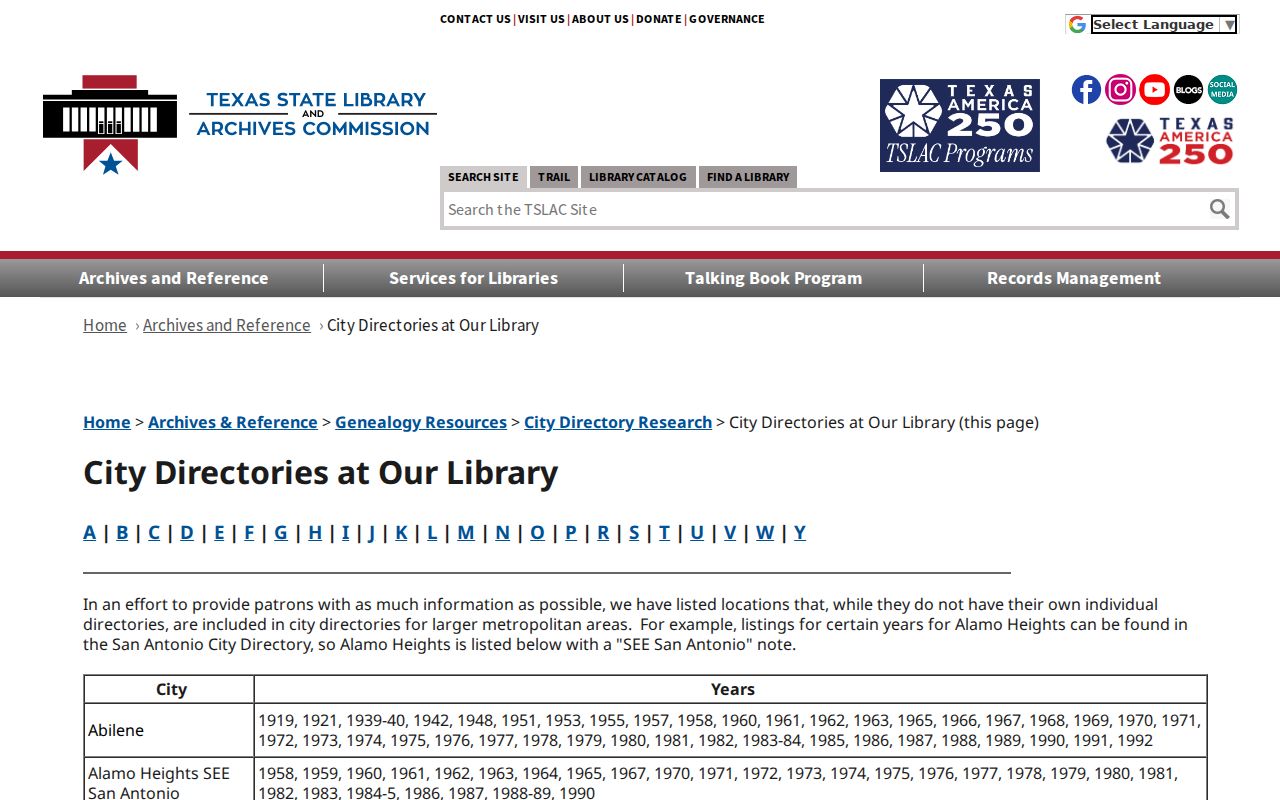
The strongest record note for a historical directory combines the publication year, repository, volume or page, image number, spelling searched, and whether the page scan was read. That makes the finding reproducible without exposing more information than the historical question requires.