
Finding Irving Resident Records
Irving has no single official list of everyone who lives there. The useful records are split by purpose. Dallas Central Appraisal District, called DCAD, ties an owner name to a taxable parcel. The Dallas County Clerk indexes recorded instruments. Irving Municipal Court and the Dallas County Courts Portal cover different courts. Older names and addresses often appear in the Irving Archives or a city directory. A result identifies a relationship to that record, such as owner of record, party to a case, or directory entry. It does not prove that someone currently occupies an address.
Choose the first route by the question. An address usually starts at DCAD. A property transfer begins with the deed index. A name from a family history project may begin at the library or archives. When a record is not online, use the named custodian's counter, phone, mail form, or a narrowly described request under the Texas Public Information Act.
- Search the street address in DCAD and record the parcel account and legal description.
- Use that description, the current owner name, or a prior owner name in the County Clerk's deed index.
- Check the relevant court or election route only when its scope fits the question and access rule.
- For a dated household, compare city directories, telephone books, archive material, and newspaper sources.
- Ask the office holding a specific existing record when an index, image, or year range is unavailable.
Note: Save the portal, search date, terms, and record identifier so an Irving result can be checked again later.
Irving Residents Records Offices
Irving sits in Dallas County, so the City Secretary, County Clerk, DCAD, and Elections office each keep a different part of the records trail. The County Clerk is the recorder for deeds, plats, liens, assumed-name filings that remain county records, and many related documents. DCAD is the appraisal and parcel-address layer, not the deed recorder. The City Secretary handles municipal records and the City's public-information route. Those distinctions prevent a request for an address record from landing at the wrong office.
Dallas County Clerk Recording Division
Records Building, 500 Elm Street, Suite 2100
Dallas, TX 75202
214-653-7099
Dallas Central Appraisal District
2949 N Stemmons Freeway
Dallas, TX 75247-6195
Address-correction route: MappingGIS@dcad.org
Dallas County Elections
1520 Round Table Drive
Dallas, TX
469-627-8683
Voter-registration lookup route
The City Secretary's Open Records route asks requesters to check the Open Data Portal first, then submit a request for an existing city record. It is not a request for the City to create a new resident report.
Irving Addresses in DCAD
DCAD's By Address search is a practical first stop when an Irving street address is known. It separates the address number and street name, then offers direction, building, suite, city, range, and account-type controls. Street type is not entered in this form. DCAD documents a percent wildcard and an X% convention for a one-letter street. Results can show an address, city, owner or business name, total value, and account type. Treat the owner field as an appraisal record, not an occupancy finding.
| DCAD field | Use in an Irving address search |
|---|---|
| Address Number | Required part of the street address. |
| Street Name | Required, at least two characters and no spaces. |
| Direction and City | Selections that help narrow the address. |
| Building, Suite, From/To | Optional details for unit or address-range work. |
| Account Type | Residential, Commercial, or BPP. |
The DCAD address-search screen shows the fields used for an Irving residents directory address trail.
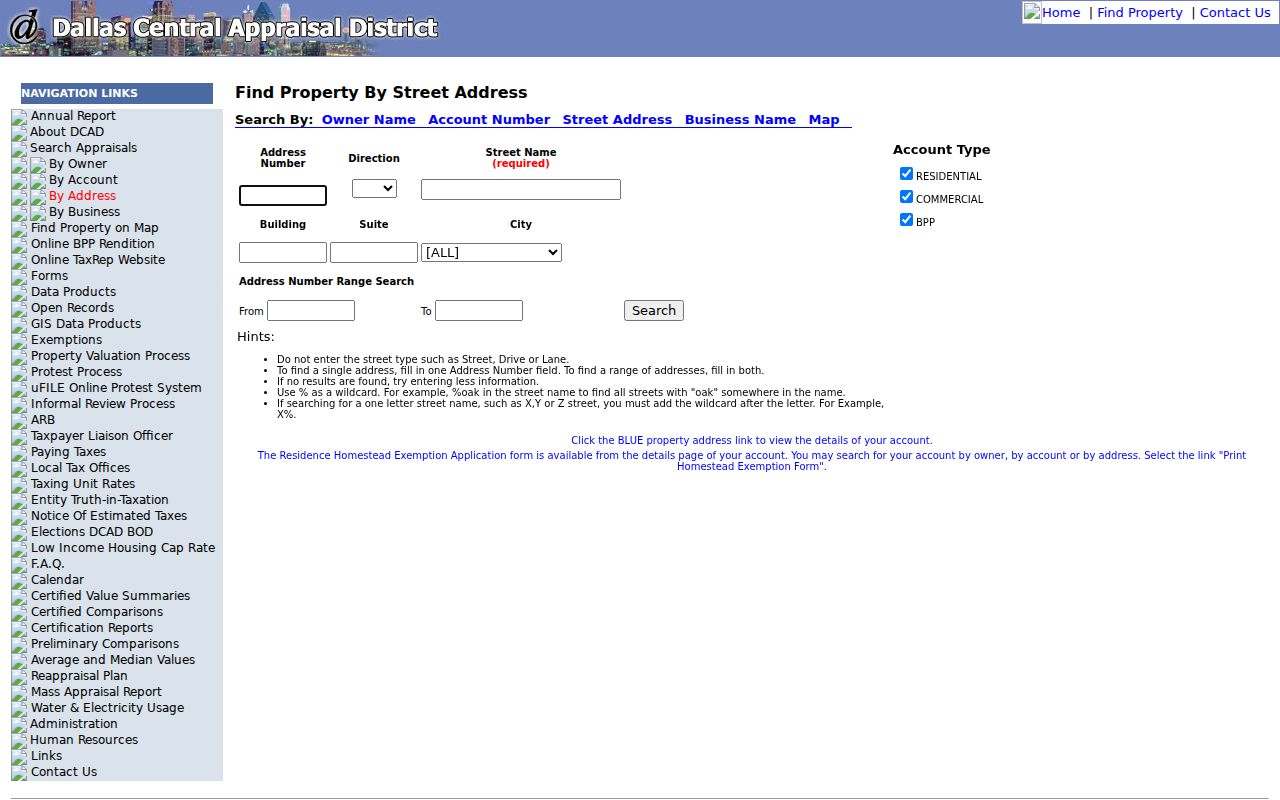
Keep the account number and legal description with the address, then use them to compare a deed or plat without relying on a street label alone.
Dallas Deeds Behind Irving Addresses
The Dallas County deed and property index follows a different trail. Its Quick Search and Advanced Search accept a grantor, grantee, subdivision, document type, document number, and date range. A grantor conveys an interest; a grantee receives one. Those indexed parties identify their role in the recorded instrument, not necessarily a current home address. The County Clerk says real-estate records are digitized from 1846 to current, a longer span than Irving's founding in 1903.
Begin with the DCAD parcel details, then search a prior or present owner name, subdivision, or legal-description terms. Use the index first and obtain a certified copy from the Clerk only when a certified document is needed. The Clerk also accepts a mail request with grantor or grantee, instrument number, document type, property address, copy choice, payment, and a prepaid return envelope. Plain copies are listed at $1 per page; certified copies add $5 per document.
- Parcel
- A specific appraisal account or mapped piece of property.
- Legal description
- The recorded lot, block, subdivision, or survey wording that identifies land.
- Grantor / grantee
- The party transferring an interest / the party receiving it.
- Index
- A searchable record pointer, which may not be the same as a certified document image.
A deed chain is most useful when it is paired with the parcel and a retrieval date, especially if a name is common.
Note: Dallas County advises that online property information can change, so verify an important instrument with the Clerk.
Current Irving Resident Directories
Current Irving sources are narrow by design. DCAD records an appraisal owner or business name. The deed index names document parties. Courts identify parties in a particular jurisdiction. The voter lookup concerns status, subject to confidentiality rules. City permits or code records can concern a property but do not establish a resident. For a person's name, use the source that describes the relationship you need, then cross-check it against a separate source and date.
| Irving record layer | Relationship it can show | Custodian | Access route |
|---|---|---|---|
| DCAD appraisal roll | Owner or business name tied to an account | DCAD | Address, owner, account, business, or map search |
| Recorded-property index | Grantor, grantee, or other instrument party | Dallas County Clerk | Online index, counter, mail, and e-certification where eligible |
| Voter-status route | Permitted registration-status information | Dallas County Elections | County lookup, elections office, and SOS forms |
| Municipal records | Record-specific city relationship | Irving City Secretary or department | Portal, department contact, or public-information request |
| Historic directories | Dated directory entry or household association | Libraries and archives | Archive, library, microfilm, and digitized collection |
When the question is about one named person rather than an address or collection, the Irving resident lookup route keeps the court, vital, historical, and property searches in their proper lanes.
Older material has additional access channels. Dallas Public Library's Dallas History and Archives offers directories, telephone books, newspapers, maps, county records, and reference help. Its genealogy resources include surname-indexed vertical files, microform, FamilySearch Affiliate computers, and newspaper databases. Irving Public Library has both remote-with-card and in-library database access for selected products. Ask for the collection, year, or finding aid that fits the person or address instead of asking a repository to build a new list.
Irving Court Searches by Custodian
There is no universal court search for Irving. The Dallas County Courts Portal uses Smart Search with required last and first name, an optional middle name, name type, court location, and party-name or cause-number modes. Irving Municipal Court separately handles Class C traffic and city-ordinance matters, with its own case-search, docket, and records-request routes. A match must be tied to its court, case number, filing date, and party role.
For a county result, the Clerk counter or a records request is the fallback when a document is not available online. Municipal Court offers records and docket links. Federal matters use federal court systems, not either local portal. A court index match is not a conclusion about a person's identity or history.
The Dallas County Smart Search screen is the county-level starting surface.
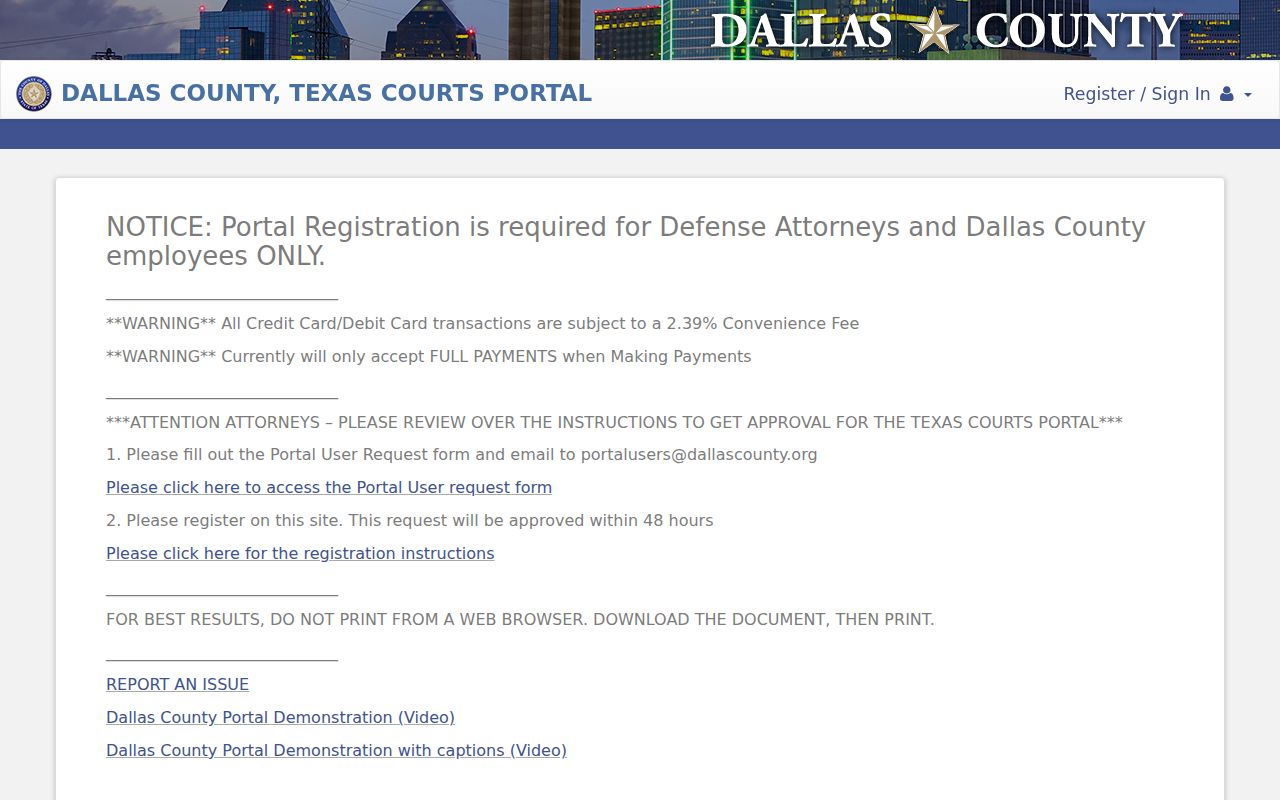
Use a full name, a time period, and a court location where possible, then confirm the person from the docket details rather than the name alone.
Voter Status and Protected Addresses
Dallas County's voter-status lookup is linked from Irving Elections, but the page returned HTTP 403 during research, so its current field labels and result columns should not be guessed. The documented fallback chain is Dallas County Elections, the Texas Secretary of State's voter-information route, and the State's request forms where permitted. Public voter information has limits. Texas identifies confidential fields and provides ways for eligible voters to suppress residence information from a website.
Texas SOS confidentiality procedures include protections for qualifying officials and certain victims, as well as an address-confidentiality program. Form 21-19 is a voter-registration confidentiality request filed with the elections administrator or county voter registrar with supporting proof. A voter record must never be treated as permission to republish a protected address or personal identifier.
The Dallas voter-status route was captured as an access path, not as proof of its unretrieved live fields.
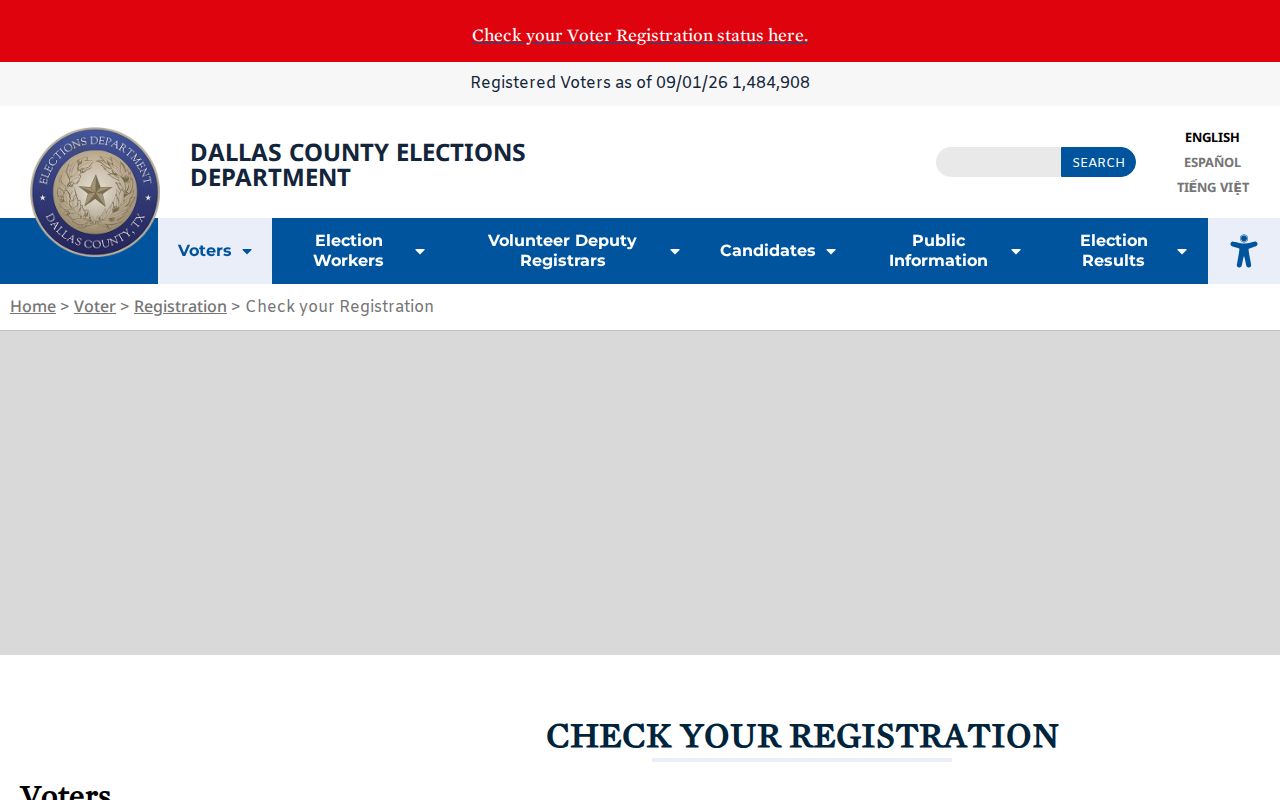
The county phone and the Texas SOS confidentiality rules are safer alternatives when the online form does not load.
When Irving Records Are Offline
A failed search does not establish that a record does not exist. Dallas County Central Records announced a service and move notice effective April 6, 2026; during that move, some criminal, probate, civil, and other year ranges may be unavailable or held at stated locations. Check the Central Records notice before a visit. The City may hold its own municipal record, while the County Clerk, court clerk, library, or archive holds another piece.
For a County Clerk document, use the online index, counter, phone, e-certification when eligible, or the mail form. For City material, use the relevant department or a written request to the City Secretary. The Texas Public Information Act guidance calls for a request to a custodian for an existing, reasonably described record. It does not require an agency to create a new compilation.
Note: Write down the office, portal, date, and the exact record requested before moving to the next access channel.
Historic Irving Resident Directories
Historical evidence is often more direct than a modern broad search. Dallas Public Library lists Irving City Directory holdings for 1937, 1954-55, 1961-64, 1966, 1968-79, and 1981, along with runs of Irving telephone directories. The Texas State Library lists additional Irving directory years. The Portal to Texas History provides digitized Dallas volumes with Irving pages. These are periodic collections, not a continuous annual list.
A dated directory entry can place a household or business at an address in that edition. It should be read with the page image and the volume's abbreviations, then compared with directories from nearby years, newspapers, archives, or a deed. The full year-by-year method is kept with the Irving city directory collections.
Irving Archives and Street Clues
The Irving Archives holds municipal, school, church, club, business, photograph, oral-history, and newspaper material. Its named collections include the 1905 Parrish Brown House, material on the Rock Island survey crew, 1925 community lantern slides, and school class photographs from 1912 through 1950. This is a local-history route for a family, address, school, or institution, not a source for a present-day resident list.
The 1937 directory also preserves a useful street-history check: it notes that IRWIN AV changed to Marburg and IRWIN DELL changed to Irwindell. Search both present and historic street forms in directories, deeds, plats, and mapping records. The research did not find an official citywide renumbering date or before-and-after crosswalk.
The Texas vital-record order screen shows why current vital documents use a separate, eligibility-controlled route.
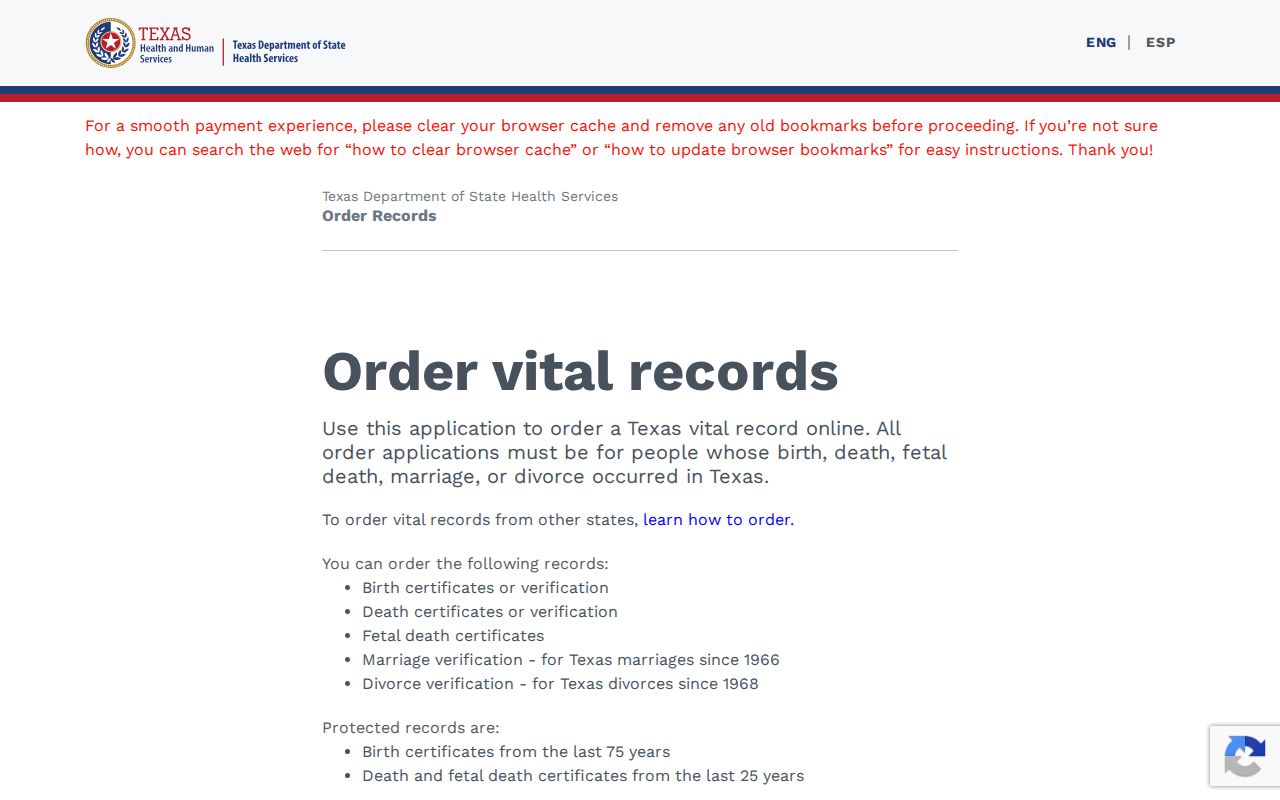
Texas makes birth records public after 75 years and death records after 25 years; current protected records require the issuing office's qualified-requester, ID, and fee process.
For a historical death notice or family connection, the Irving Archives also lists digitized Irving newspaper obituaries from 1908 through 2015. Dallas Public Library and its affiliated research resources broaden the newspaper search. OCR can miss initials, street names, and unusual surnames, so inspect the page image before treating a match as evidence.
Irving Neighborhood Records Context
Irving Neighborhood Services supports voluntary association registration, maps, grants, training, communication, and community involvement. It can provide civic context for an address without identifying occupants. The City's Heritage District page gives a precise example, defining boundaries with named roads and reporting its acreage, unit mix, commercial properties, and community organizations. Those figures describe the district, not a roster of residents.
For an address project, keep the sequence narrow: standardized address, parcel account, mapped subdivision or plat, recorded instrument, historic directory, then neighborhood plan. The DCAD map warns that its boundaries are approximate and are not a legal survey. Irving Planning's interactive map and the recorded plat are better sources when subdivision or zoning context matters.
Irving Search Results Need Context
Official sources and commercial search categories differ in a basic way. An official index names its custodian, record type, jurisdiction, and access rules. A commercial result may combine stale or mismatched material and often obscures the original record. Start with the official index when a property, court, vital, election, or archive source exists. Then save the source date and identifier rather than making a new profile from unrelated entries.
| Record question | Best Irving starting point | What to preserve |
|---|---|---|
| Owner of a parcel | DCAD, then County Clerk instrument index | Account number and legal description |
| Past household | Directory, archive, or library collection | Edition year, page, and repository |
| County case match | Dallas County Courts Portal | Cause number, court, and filing date |
| City record | Irving department or City Secretary | Custodian and narrowly described record |
Texas privacy rights do not erase a properly held government deed, court item, or required voter record. They do reinforce the need to use only the minimum non-sensitive information needed to verify a record.